Friday, May 8, 2009

Stickleblog: The stickleback family tree, part 2

ResearchBlogging.orgSome weeks ago, I discussed a large phylogenetic study that separated sticklebacks from the seahorses and pipefishes - today I'm going to discuss a phylogenetics paper that zooms in on the relationships between different sticklebacks(and their very closest relatives).

Many of the same scientists from the earlier stickleback phylogeny were involved in this paper, though there is one new face, Yale's Tom Near, a longtime Wainwright Lab collaborator and former CPB Postdoc.

The group sequenced the mitochondrial genomes of all nine sticklebacks and stickleback relatives, and they also sequenced 11 nuclear genes. They used both maximum-likelihood and Bayesian methods to estimate a phylogenetic tree of sticklebacks.

Here's what they found:


The mitogenome and nuclear gene data dovetail beautifully, as do the maximum-likelihood and Bayesian methods for each dataset, so there's every reason to feel confidant about this arrangement of species.

There are a number of interesting results here: Aulorhynchidae, the family that includes the tubesnout, turns out to be paraphyletic - perhaps the Aulorhynchidae should be folded into the family Gasterosteidae and considered proper sticklebacks?

The thing I find the most interesting is the phylogenetic position of Spinachia spinachia, an elongated stickleback similar in appearance to the tubesnout. The paper suggests that perhaps Spinachia's elongate form is the result of convergent evolution.

It's also worth thinking about the geographical distribution of stickleback in the context of this phylogeny: Spinachia and Apeltes, two Atlantic Ocean-only species, are grouped together, while the most basal stickleback relatives are all found in the North Pacific.

There are some interesting future directions possible here as well. One of Tom's specialties is using fossil data to calibrate phylogenies, so it's likely we'll see a phylogeny in the near future that gives us an idea of the timescales of major stickleback divergence events.

KAWAHARA, R., MIYA, M., MABUCHI, K., NEAR, T., & NISHIDA, M. (2009). Stickleback phylogenies resolved: Evidence from mitochondrial genomes and 11 nuclear genes Molecular Phylogenetics and Evolution, 50 (2), 401-404 DOI: 10.1016/j.ympev.2008.10.014

Friday, May 1, 2009

Stickleblog: Sticklebacks at work

ResearchBlogging.orgToday's Stickleblog deals with a recent paper in the journal Nature by Luke Harmon(a contributor on the blog Dechronization - check it out!), Dolph Schluter, and a number of other folks.

The paper features the threespine stickleback species pairs, which have become a famous evolutionary model system in the last several decades. In a few British Columbia lakes, you can find not one but two different kinds of stickleback - a small slim "limnetic" form that eats zooplankton in open areas of the lake, and a large deep-bodied "benthic" form that eats small invertebrates on the lake bottom.

A lot of work has already been done on the stickleback species pairs, but Harmon and the others took things in a new direction and examined whether these two specialized sticklebacks could affect the lake environment itself -- in other words, are sticklebacks ecosystem engineers?

To answer the question, the researchers set up large outdoor tanks using sediment and small invertebrates from an actual stickleback lake. Then, they added fish: one set of tanks received only the limnetic, another received only the benthic, another received both limnetic and benthic, and the last set received generalist sticklebacks from a single-species lake.

The type of sticklebacks added to the tank had an effect on the invertebrate community - if the tank had limnetic sticklebacks(or limnetic+benthic), there were far fewer calanoid copepods. There were also large differences between the generalist stickleback tanks and the species-pair tanks in primary production.

The most striking finding was that sticklebacks had an effect on the clarity of water; generalist sticklebacks had significant more transparent water than any of the other treatments, and species-pair treatments had the least clear water.

A lot more work will be required to uncover exactly how the sticklebacks are producing these effects, but it seems that the difference between one generalist stickleback and an adaptive radiation of two specialist sticklebacks can have important consequences for the habitats they live in.

Harmon, L., Matthews, B., Des Roches, S., Chase, J., Shurin, J., & Schluter, D. (2009). Evolutionary diversification in stickleback affects ecosystem functioning Nature, 458 (7242), 1167-1170 DOI: 10.1038/nature07974

Friday, April 24, 2009

Stickleblog: What happens when you put a stickleback and a trout together?

ResearchBlogging.orgOne of the most striking features of marine stickleback is the row of bony armor plates that run along the side of the body. These "armor plates" are actually enlarged and ossified lateral line scales, and they're a unique feature of threespine stickleback; other sticklebacks (and tubesnouts) just have a tiny row of lateral scales at the most.


Threespine stickleback, fully armored form
(illustration from Wikimedia Commons)


Freshwater stickleback populations will often have few to no armor plates, which has prompted biologists to look into the both the genetic basis of armor loss and the effect of natural selection on plate number.

In 1992, Canadian ecologist Tom Reimchen published a paper in Evolution that shed some light on the latter question.

Tom captured wild stickleback from a freshwater lake and then put them in an enclosure with one of their chief lake predators, the cutthroat trout. Predictably, the trout would bite the stickleback and try to eat it; whenever a bitten stickleback escaped or was spit out, Tom caught it. The first 153 fish were simply preserved, and the last 143 fish were placed in aquariums and monitored for several days to see if their injuries were fatal.

Then, Tom took a look at what sort of injuries all 296 stickleback had sustained from the trout attack. In particular, were stickleback with more armor plates injured less frequently than stickleback with fewer plates? It turned out that puncture wounds from trout teeth were significantly less common in more armored stickleback.


Top graph: plate number versus puncture wounds sustained
Bottom graph: plate number versus survival


In the second group of 143 fish that had been monitored for survival, over half of the fish died, many of whom did not survive the first 24 hours (for those wondering, Tom did have a control tanks of non-injured fish in the same room - they all survived). Fish with more plates survived significantly longer than fish with fewer plates; in addition, fish with injuries exhibited significantly lower survival.

Taken together, the results suggest that having more armor plates results in fewer injuries sustained from predators, which increases the fish's chances of survival if it escapes being eaten.

There is one interesting caveat, though: all of these fish would still qualify as "low-plated" freshwater stickleback. Most of the plate variation involved the presence of a few additional plates closer to the head - does this mean that fully-plated marine fish get the same sort of protective benefit from having armor closer to the tail?

Reimchen, T. (1992). Injuries on Stickleback from Attacks by a Toothed Predator (Oncorhynchus) and Implications for the Evolution of Lateral Plates Evolution, 46 (4) DOI: 10.2307/2409768

Thursday, April 23, 2009

Dechronization interviews Joe Felsenstein

Just in case anyone is reading this blog who is not also reading Dechronization, I have two things to say. First, what is wrong with you? Second, Luke Harmon and Dan Rabosky just posted a great interview of Joe Felsenstein, which you should read. If you don't know who that is, see point 1 above. You can find the interview here.

Friday, April 17, 2009

Stickleblog: Spotlight on Aulorhynchus flavidus


(Image courtesy of Wikipeda)

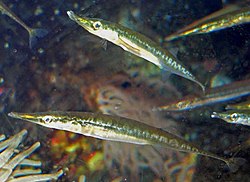
In past entries, I've made reference to the tubesnout(Aulorhynchus flavidus), an odd little creature that's closely related to the sticklebacks.

Tubesnouts are currently part of the family Aulorhynchidae, sister group to the Gasterosteidae(sticklebacks). Unlike the stickleback-sygnathiform relationship, the stickleback-tubesnout relationship is supported by molecular and morphological data, so it's unlikely to change any time soon.

At a quick glance, a tubesnout looks like a little like a pipefish, but if you look closer, you'll see that it actually looks like a stickleback that's been stretched out. Tubesnouts have the "iconic" stickleback features, though they're not as obvious: instead of a few big dorsal spines, they have many very small spines, and instead of "armor"(which is actually not that common on most sticklebacks) they just have a small row of lateral line scales. Their pelvic girdle is not as robust as a threespine's and their pelvic spines are small and lack serrations, though they do have red pelvic fin webbing like a threespine stickleback.

The mating system of the tubesnout bears some similarity to that of other sticklebacks, namely, males glue together vegetation to make small nests. Males also exhibit specific color patterns during the breeding season; the male tubesnouts that I've observed have a patch of black next to a patch of white on the head.

The most striking feature of the tubesnout is its elongated body and head. Many teleosts exhibit elongation (anguilliformes being the most notable), but few have elongation in both the body and the head. (though they do exist) Perhaps the most interesting thing about elongation and the tubesnouts is that there is reason to believe that elongation is ancestral in sticklebacks. Spinachia spinachia, the sea stickleback, is elongated - if phylogenetic analysis shows that it is the most basal stickleback species, it is possible that the common ancestor of the sticklebacks was elongated, and that some sticklebacks evolved a more classic fishy shape.

Friday, April 10, 2009

Stickleblog: Spines hurt, according to predators

ResearchBlogging.orgOne of the distinguishing features of sticklebacks is that instead of having pelvic and dorsal fins, they have serrated bony spines that the fish can lock into place(more on the locking in a later entry).

Why would evolution result in a lineage of fishes that has spines instead of fins? The classic explanation is that spines make sticklebacks a painful meal; predators will avoid eating sticklebacks if other food is available.

In 1956, Hoogland et al tested whether stickleback spines were an effective defense against larger fish. The paper itself is 33 pages, with multiple experiments - for today's entry, I'm going to concentrate on only two of these.

In the first experiment, pike were presented with three different types of fish: 12 threespine sticklebacks, 12 ninespine sticklebacks, and 12 carplike fish lacking spines. At first, the pike went after sticklebacks, with decidedly ouch-inducing results:


After eating one stickleback of each type, the pike focused exclusively on the fish without spines, eating all 12 of them in 5 days. Once all of these were gone, sticklebacks started disappearing, but at a much slower pace, with ninespine stickleback eaten faster than threespines. It's difficult to conclude anything too comprehensively from this, as the authors didn't do much in the way of replication, but it does suggest that fish predators prefer nonspined prey.

Then, the authors tried the obvious experiment - if threespine stickleback have spines that make it difficult for predators to eat them, what happens if the spines are removed? Once the spines were removed from a stickleback, predators stopped spitting them out and treated them similarly to the carplike fish.

Provided one is willing to overlook the paper's archaic methodology and lack of rigorous statistical methods(and it is from the 1950s, remember), spines appear to decrease the deliciousness of stickleback.

Perhaps that's why sticklebacks have never really taken off as a cuisine...

R. Hoogland, D. Morris and N. Tinbergen (1956). The Spines of Sticklebacks (Gasterosteus and Pygosteus) as Means of Defence against Predators (Perca and Esox) Behaviour, 10 (3), 205-236 DOI: 10.2307/4532857

Friday, April 3, 2009

Stickleblog: Plastic stickleback

ResearchBlogging.orgWhen I was an undergraduate at UNC, I worked in the Pfennig lab on spadefoot toads, which exhibit a striking form of polyphenism. Polyphenism occurs when one genotype can produce multiple phenotypes in response to environmental conditions. As it turns out, stickleback have polyphenic traits too!

Matthew Wund
in Susan Foster's lab at Clark University published a paper in American Naturalist this past year that deals with an especially interesting form of plasticity called the "flexible stem" hypothesis. The idea is that polyphenism in an ancestral species may influence the pattern of diversification in its descendant lineages.

Stickleback are a great system for testing this idea, because freshwater sticklebacks have repeatedly diverged into "benthic" and "limnetic" forms when the ancestral marine form colonized freshwater habitats at the end of the last glaciation period.

Matthew and the Foster lab collected stickleback from a marine population, a freshwater limnetic population, and a freshwater benthic population, and bred them in the lab. They then took the young sticklebacks and fed them either limnetic food(small swimming crustaceans) or benthic food(bottom-dwelling insect larva).


Interestingly, the head morphology of marine fish changed; fish fed a benthic diet developed a head that looked like a benthic freshwater fish, and marine fish fed a limnetic diet developed a limnetic-like head.

The ancestral marine fish exhibit a polyphenism that resembles the descendent freshwater populations, which suggests that this ancestral polyphenism may be important in governing how a lineage diversifies.


Wund, M., Baker, J., Clancy, B., Golub, J., & Foster, S. (2008). A Test of the “Flexible Stem” Model of Evolution: Ancestral Plasticity, Genetic Accommodation, and Morphological Divergence in the Threespine Stickleback Radiation The American Naturalist, 172 (4), 449-462 DOI: 10.1086/590966