Showing posts with label phylogenetics. Show all posts

Friday, May 8, 2009

Stickleblog: The stickleback family tree, part 2

ResearchBlogging.orgSome weeks ago, I discussed a large phylogenetic study that separated sticklebacks from the seahorses and pipefishes - today I'm going to discuss a phylogenetics paper that zooms in on the relationships between different sticklebacks(and their very closest relatives).

Many of the same scientists from the earlier stickleback phylogeny were involved in this paper, though there is one new face, Yale's Tom Near, a longtime Wainwright Lab collaborator and former CPB Postdoc.

The group sequenced the mitochondrial genomes of all nine sticklebacks and stickleback relatives, and they also sequenced 11 nuclear genes. They used both maximum-likelihood and Bayesian methods to estimate a phylogenetic tree of sticklebacks.

Here's what they found:


The mitogenome and nuclear gene data dovetail beautifully, as do the maximum-likelihood and Bayesian methods for each dataset, so there's every reason to feel confidant about this arrangement of species.

There are a number of interesting results here: Aulorhynchidae, the family that includes the tubesnout, turns out to be paraphyletic - perhaps the Aulorhynchidae should be folded into the family Gasterosteidae and considered proper sticklebacks?

The thing I find the most interesting is the phylogenetic position of Spinachia spinachia, an elongated stickleback similar in appearance to the tubesnout. The paper suggests that perhaps Spinachia's elongate form is the result of convergent evolution.

It's also worth thinking about the geographical distribution of stickleback in the context of this phylogeny: Spinachia and Apeltes, two Atlantic Ocean-only species, are grouped together, while the most basal stickleback relatives are all found in the North Pacific.

There are some interesting future directions possible here as well. One of Tom's specialties is using fossil data to calibrate phylogenies, so it's likely we'll see a phylogeny in the near future that gives us an idea of the timescales of major stickleback divergence events.

KAWAHARA, R., MIYA, M., MABUCHI, K., NEAR, T., & NISHIDA, M. (2009). Stickleback phylogenies resolved: Evidence from mitochondrial genomes and 11 nuclear genes Molecular Phylogenetics and Evolution, 50 (2), 401-404 DOI: 10.1016/j.ympev.2008.10.014

Friday, April 17, 2009

Stickleblog: Spotlight on Aulorhynchus flavidus


(Image courtesy of Wikipeda)

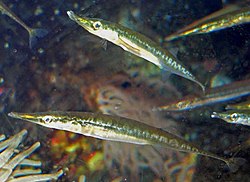
In past entries, I've made reference to the tubesnout(Aulorhynchus flavidus), an odd little creature that's closely related to the sticklebacks.

Tubesnouts are currently part of the family Aulorhynchidae, sister group to the Gasterosteidae(sticklebacks). Unlike the stickleback-sygnathiform relationship, the stickleback-tubesnout relationship is supported by molecular and morphological data, so it's unlikely to change any time soon.

At a quick glance, a tubesnout looks like a little like a pipefish, but if you look closer, you'll see that it actually looks like a stickleback that's been stretched out. Tubesnouts have the "iconic" stickleback features, though they're not as obvious: instead of a few big dorsal spines, they have many very small spines, and instead of "armor"(which is actually not that common on most sticklebacks) they just have a small row of lateral line scales. Their pelvic girdle is not as robust as a threespine's and their pelvic spines are small and lack serrations, though they do have red pelvic fin webbing like a threespine stickleback.

The mating system of the tubesnout bears some similarity to that of other sticklebacks, namely, males glue together vegetation to make small nests. Males also exhibit specific color patterns during the breeding season; the male tubesnouts that I've observed have a patch of black next to a patch of white on the head.

The most striking feature of the tubesnout is its elongated body and head. Many teleosts exhibit elongation (anguilliformes being the most notable), but few have elongation in both the body and the head. (though they do exist) Perhaps the most interesting thing about elongation and the tubesnouts is that there is reason to believe that elongation is ancestral in sticklebacks. Spinachia spinachia, the sea stickleback, is elongated - if phylogenetic analysis shows that it is the most basal stickleback species, it is possible that the common ancestor of the sticklebacks was elongated, and that some sticklebacks evolved a more classic fishy shape.

Friday, March 27, 2009

Stickleblog: The stickleback family tree

ResearchBlogging.orgUntil recently, sticklebacks were thought to be pretty closely related to seahorses and pipefish. At first glance, it seems reasonable: both groups of fish have bony armor plates, male parental care, and species with elongated bodies and snouts. Many of the species also share a mode of swimming called "labriform" that I'll be talking about more in a later entry.

So, the pipefishes and sticklebacks share parental care, bony armor, elongation, swimming mode - seems like a slam dunk, right? Wrong.

Things are rarely that simple when you're dealing with the incredible diversity of teleost fishes, particularly within the Percomorpha, often referred to as the "bush at the top of the tree of life". Fish are just too diverse for simple morphology-based relationships - you need genetic data to really see what's going on, and you need a lot of it, because there are so many groups.

In a paper published early last year, Kawahara et al used 75 sequenced mitogenomes to generate a phylogeny of the Gasterosteiformes and related species, and...bam, there goes the neighborhood!


Gasterosteiformes(bolded in the figure above) was split into three pieces: seahorses, pipefishes and their relatives ended as sister to the gurnards, the weird indostomids were sister to the weird synbranchiformes, and finally, the closest relatives of the Gasterosteidei(sticklebacks) were eelpouts and pholids.


A pholid (from Wikimedia Commons)

Obviously, there's still a lot of work to be done with these fishes - nuclear genes need to be sequenced to back up the mitochondrial genome data, and given the number of species in the presumed stickleback sister group, it's conceivable that there could be a paraphyly issue as well.

Either way, it looks like the sticklebacks are in for a wild ride!

KAWAHARA, R., MIYA, M., MABUCHI, K., LAVOUE, S., INOUE, J., SATOH, T., KAWAGUCHI, A., & NISHIDA, M. (2008). Interrelationships of the 11 gasterosteiform families (sticklebacks, pipefishes, and their relatives): A new perspective based on whole mitogenome sequences from 75 higher teleosts Molecular Phylogenetics and Evolution, 46 (1), 224-236 DOI: 10.1016/j.ympev.2007.07.009

Friday, February 13, 2009

Woodchipper - a script for breaking phylogenetic trees into subclades

Here's a handy little Perl script I wrote that takes a nexus formatted tree file and breaks down every tree that it finds into the clades that it is composed of (i.e., every node in the starting tree is returned as a new tree). It spits all of these out into a text file, which can then be copied and pasted into a tree block.

Each tree in the original file gets its own text file, named woodchipper_treename.tre, where "treename" is the name of the tree given in the trees block in the input file.

It hasn't been tested exhaustively yet, so please check the results and contact me if you run into any trouble. No warranty is expressed or implied, your mileage may vary, not valid where prohibited, and all that.

NOTE: If you're having trouble saving the link above, try right click -> save as instead of clicking on it in the normal way.