Sunday, August 16, 2009

Mysteries in Fish Functional Morphology 2. Halfbeaks

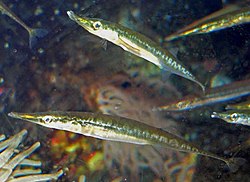
Look at the head and jaws of a halfbeak:

The lower jaw appears very elongate, reaching as much as ten times further than the upper jaw. What is the function of this bizarre anatomy? Is it used in feeding? Is it used in locomotion? If so, how?

Halfbeaks (Hemiramphidae) are related to needlefish, flying fish and sauries. They are slender-bodied fish that spend most of their time swimming right up at the surface of the water where they are expert at hiding from predators. They mainly occupy warm and temperate inshore marine habitats, though there is also a radiation of freshwater forms. The marine species feed on drifting pieces of plants and zooplankton. The freshwater species and most inshore marine forms also eat drifting surface insects.

Once you get past the very strange appearance of these fish and closely inspect the head you find that the long lower jaw is not actually a lower jaw but instead an absurdly long chin (have a look at the diagrams below from Montgomery & Saunders 1985). The toothed lower jaw is short and matches the toothed upper jaw. The halfbeak is actually a very long extension of the part of the mandible that is below, and in front of the teeth - a chin. The structure is smooth and not armed with teeth. This is our first clue that the structure is not an elaborate jaw used in prey capture. If it's not part of the feeding apparatus, then how does it function?


One idea that has some support is that the long chin is part of a specialized sensory devise. Montgomery & Saunders (1985a) showed that there are a series of lateral line pores along the length of the lower jaw, with neuromasts in between these pores. They argued that this long structure, equipped with the lateral line pits, may function in prey detection. The species they worked with feeds at night on large zooplankton and they showed it is capable of detecting live plankton in total darkness. In effect, they argue that the halfbeak functions as an extension of the lateral line system that may aid these fish in nocturnal attempts to locate moving prey animals in midwater habitats.

This is a fascinating proposal that may help us understand the function and evolution of the halfbeak. But the system requires more attention before we fully understand how it works and how it evolved. It would be valuable to model the potential sensory advantage of the long, sensitive chin. Does it convey a major performance advantage over fish that lack such a device? What was the evolutionary sequence here? Did the long chin evolve as a specialization of the lateral line system, or did the long chin evolve first for a different function, and then become co-opted for use as a scaffolding for the sensory system? And, what role does the long lower jaw play during prey capture? Such a large structure must interact with prey during feeding. Are there other, secondary functions of the long chin? What do you think?

Montgomery, J.C. & A.J. Saunders. 1985. Functional morphology of the piper Hyporhamphus ihi with reference to the role of the lateral line in feeding. Proc. Roy. Soc. Ser. B. 224:197.

Saunders, A.J. & J.C. Montgomery. 1985. Field and laboratory studies of the feeding behavior of the piper Hyporhamphus ihi with reference to the role of the lateral line in feeding. Proc. Roy. Soc. Ser. B. 224:209.

Monday, July 6, 2009

Modeling the distribution of sasquatch - the first published study using ENMTools

Lozier, Aniello, and Hickerson just published a paper in the Journal of Biogeography in which they use sasquatch sightings and footprints to model the distribution of this elusive imaginary species. They went one step further and modeled the effects of climate change on sasquatch distributions, showing that our furry friends are only going to become more elusive with time. Finally, they used ENMTools to demonstrate that sasquatch distributions were statistically indistinguishable from those of the black bear, suggesting that many of the bigfoot sightings may have been a case of mistaken identity.

Just to put a punchline on the whole thing, the public response to the New Scientist article about the study has led to a rush of public comments claiming that the study is biased due to the a priori assumption that sasquatch isn't real.

Friday, June 5, 2009

Stickleblog: 80s stickleback (but without the crazy hair)

ResearchBlogging.orgBack in the early 80s, Don McPhail worked on sticklebacks in Vancouver Island, and specifically in some intriguing lakes that had not one but two different species of sticklebacks in them. Ten years later, McPhail and Schluter would build on this research and help to catapult stickleback to the forefront of evolutionary biology.

But for now, let's go back to the 80s and look at a little paper with big implications.

The Enos Lake stickleback species pair consisted of a benthic species and a limnetic species, though they are sadly no longer with us due to an invasive species introduction. As is generally the case with these species pairs, benthics are larger, with deep bodies and small short gill rakers, whereas limnetics are smaller with slim bodies and lots of long filamentous gill rakers.

However, morphological differences do not necessarily translate into ecological differences, so the authors tested the performance of the different species on its preferred habitat. Three experiments were performed: a prey size trial, a feeding trial on benthic substrate, and a plankton feeding trial.

In the size trial, benthics ate significantly larger prey than either limnetics or hybrids between the two forms. In the feeding trial on the benthic substrate, limnetics and benthics made similar numbers of strikes, but benthics were significantly more successful at capturing prey. In the zooplankton trial, the stomachs of limnetic stickleback contained a much higher number of prey items than than the stomachs of benthic stickleback.

The performance data from these three experiments supports the hypothesis that the Enos Lake stickleback pair does have ecological as well as morphological differentiation, though there are some interesting issues with limnetic stickleback in particular. When the authors allowed female limnetics to feed on the benthic substrate, the sticklebacks did not, though male limnetics fed freely, and made just as many feeding strikes as benthics of both sexes.

A possible reason might be that male limnetic stickleback have to spend time near the benthos to construct their nests, so it would make sense to eat benthic prey items, whereas a female only has to approach the benthos to find a suitable male, and can spend the rest of her time in the water column eating zooplankton.

When Stickleblog returns, we'll continue our look into the species pairs with a Schluter paper that examines hybrid performance relative to limnetics and benthics.

P. Bentzen, & J. D. McPhail (1984). Ecology and evolution of sympatric sticklebacks (Gasterosteus): specialization for alternative trophic niches in the Enos Lake species pair Can. J. Zool, 62 (11), 2280-2286 DOI: 10.1139/CJZ-62-11-2280

Friday, May 29, 2009

Stickleblog: While we're on the subject of angling...

Most stickleback researchers catch their fish in two ways: setting minnow traps and seining. For a third (and rather creative) way, you'll want to check out this clip from a British fishing show:

Saturday, May 23, 2009

Catch Peter on National Geographic TV tonight!

If you're quick you might be able to catch Peter on National Geographic TV tonight on the show "Hooked On Fish". It's a great show, using stories of anglers catching huge fish as a jumping-off point to talk about some fascinating natural history and conservation issues.

If you're not fast enough to see it on the air tonight, you can at least get a sample of it here.

Friday, May 22, 2009

Stickleblog: Caught in the act

ResearchBlogging.orgThis week, I'm going to discuss a cool paper that came out of Dolph Schluter's lab in 2008. The paper zooms in on a particularly interesting part of stickleback evolution, the transition between an ancestral marine form that breeds in fresh water to a population that lives in freshwater year-round.

Usually, (and this is one of the "color-coded for your convenience" things that make stickleback a fantastic model system) you can get a good idea where a stickleback is from by looking at its armor plates. Stickleback from marine habitats tend to have a full complement of plates, whereas sticklebacks from freshwater habitats will have few to no plates:


Stickleback armor plate phenotypes: fully plated (top), partially plated(middle), low plated(bottom)

The authors sorted through hundreds of marine stickleback to find fish that had intermediate numbers of plates, which signified that they were heterozygotes for the gene that governs plate number, Eda. These fish were placed in experimental ponds and allowed to breed. Because the fish were heterozygotes for Eda, they produced offspring with high, medium, and low plates, which gave the authors a chance to observe if natural selection favored the low-plated form in freshwater.

In each pond, the frequency of the low allele increased over time, and in a similar way. There was a slight dip when fish were very young, but then frequency increased until the fish reached breeding condition. Interestingly, fish carrying the low allele grew faster and reached breeding condition sooner than fish carrying the high allele, probably because building armor plates takes energy that could be spent on growing more quickly.

The story is more complicated than that, though - not only is there a period early in life where the high allele appears to be favored, but there is also a point where fish with intermediate plates have the highest fitness, which is difficult to explain. The authors raise the possibility that the Eda gene that controls plates in stickleback may affect other traits (pleiotropy). Either way, it looks like even the most well-understood stickleback phenotype has more to tell us.

Barrett, R., Rogers, S., & Schluter, D. (2008). Natural Selection on a Major Armor Gene in Threespine Stickleback Science, 322 (5899), 255-257 DOI: 10.1126/science.1159978

Friday, May 15, 2009

Stickleblog: Sticklebacks (in) rock

ResearchBlogging.orgThere are millions of sticklebacks across the globe, but you can also find sticklebacks in fossil form. The scientific name for most fossil sticklebacks is Gasterosteus doryssus, but morphologically this fossil "species" belongs within the threespine stickleback complex.

One Miocene fossil site has offered up some fascinating insights into the pace of evolution in threespine stickleback. Today I'll be focusing on a paper that examines evolution in diet type in this unique stickleback "population".

A few weeks ago, I mentioned "limnetic" and "benthic" stickleback - two different morphs of freshwater stickleback that live in different places within a lake and eat different things. Limnetic stickleback generally swim in the open areas of the lake and feed on zooplankton like calanoid copepods. Benthic stickleback stay close to the lakebed and feed on insect larva and small crustaceans like gammarids and ostracods.

In an earlier paper, it was shown that you can identify whether a stickleback is benthic or limnetic just from tiny scratches on the teeth. That technique was applied to fossil sticklebacks, with some striking results: at different periods in time, the population changed from limnetic to benthic and back again to limnetic.

Most stickleback in this lake were limnetic, which makes a lot of sense - in order for the stickleback to be preserved in anoxic sediment, the lake had to be fairly deep, which opens up a lot of potential habitat for limnetic stickleback. In addition, the substrate the sticklebacks are buried in is called diatomaceous earth - basically, millions and millions of dead diatoms, a type of phytoplankton. Lots of phytoplankton swimming around suggests there was zooplankton that ate them, which would provide a perfect source of food for limnetic stickleback.


Fossil sticklebacks (photo courtesy of Michael Bell)

So what about the point in time where the population changed from limnetic to benthic? The authors suggest that because of the speed of the change - and because there are few sticklebacks from these rocks that are halfway between benthic and limnetic - it might be the case that the limnetic sticklebacks went extinct and were replaced by a new population of invading benthic stickleback.

Still, even if we can't say for sure whether the limnetics were replaced by benthics or whether they evolved into benthics, we can say that the benthic population evolved into a limnetic population over a few thousand years, because the pattern of tooth wear changes from the heavy markings typical of a benthic to the lighter markings typical of a limnetic.

It's rare that we can use fossils to examine how a specific population changes over time, but because we can take our understanding of modern stickleback and apply it to the fossils, we can learn a lot about the dynamics of evolutionary change.

Purnell, M., Bell, M., Baines, D., Hart, P., & Travis, M. (2007). Correlated Evolution and Dietary Change in Fossil Stickleback Science, 317 (5846), 1887-1887 DOI: 10.1126/science.1147337

Friday, May 8, 2009

Stickleblog: The stickleback family tree, part 2

ResearchBlogging.orgSome weeks ago, I discussed a large phylogenetic study that separated sticklebacks from the seahorses and pipefishes - today I'm going to discuss a phylogenetics paper that zooms in on the relationships between different sticklebacks(and their very closest relatives).

Many of the same scientists from the earlier stickleback phylogeny were involved in this paper, though there is one new face, Yale's Tom Near, a longtime Wainwright Lab collaborator and former CPB Postdoc.

The group sequenced the mitochondrial genomes of all nine sticklebacks and stickleback relatives, and they also sequenced 11 nuclear genes. They used both maximum-likelihood and Bayesian methods to estimate a phylogenetic tree of sticklebacks.

Here's what they found:


The mitogenome and nuclear gene data dovetail beautifully, as do the maximum-likelihood and Bayesian methods for each dataset, so there's every reason to feel confidant about this arrangement of species.

There are a number of interesting results here: Aulorhynchidae, the family that includes the tubesnout, turns out to be paraphyletic - perhaps the Aulorhynchidae should be folded into the family Gasterosteidae and considered proper sticklebacks?

The thing I find the most interesting is the phylogenetic position of Spinachia spinachia, an elongated stickleback similar in appearance to the tubesnout. The paper suggests that perhaps Spinachia's elongate form is the result of convergent evolution.

It's also worth thinking about the geographical distribution of stickleback in the context of this phylogeny: Spinachia and Apeltes, two Atlantic Ocean-only species, are grouped together, while the most basal stickleback relatives are all found in the North Pacific.

There are some interesting future directions possible here as well. One of Tom's specialties is using fossil data to calibrate phylogenies, so it's likely we'll see a phylogeny in the near future that gives us an idea of the timescales of major stickleback divergence events.

KAWAHARA, R., MIYA, M., MABUCHI, K., NEAR, T., & NISHIDA, M. (2009). Stickleback phylogenies resolved: Evidence from mitochondrial genomes and 11 nuclear genes Molecular Phylogenetics and Evolution, 50 (2), 401-404 DOI: 10.1016/j.ympev.2008.10.014

Friday, May 1, 2009

Stickleblog: Sticklebacks at work

ResearchBlogging.orgToday's Stickleblog deals with a recent paper in the journal Nature by Luke Harmon(a contributor on the blog Dechronization - check it out!), Dolph Schluter, and a number of other folks.

The paper features the threespine stickleback species pairs, which have become a famous evolutionary model system in the last several decades. In a few British Columbia lakes, you can find not one but two different kinds of stickleback - a small slim "limnetic" form that eats zooplankton in open areas of the lake, and a large deep-bodied "benthic" form that eats small invertebrates on the lake bottom.

A lot of work has already been done on the stickleback species pairs, but Harmon and the others took things in a new direction and examined whether these two specialized sticklebacks could affect the lake environment itself -- in other words, are sticklebacks ecosystem engineers?

To answer the question, the researchers set up large outdoor tanks using sediment and small invertebrates from an actual stickleback lake. Then, they added fish: one set of tanks received only the limnetic, another received only the benthic, another received both limnetic and benthic, and the last set received generalist sticklebacks from a single-species lake.

The type of sticklebacks added to the tank had an effect on the invertebrate community - if the tank had limnetic sticklebacks(or limnetic+benthic), there were far fewer calanoid copepods. There were also large differences between the generalist stickleback tanks and the species-pair tanks in primary production.

The most striking finding was that sticklebacks had an effect on the clarity of water; generalist sticklebacks had significant more transparent water than any of the other treatments, and species-pair treatments had the least clear water.

A lot more work will be required to uncover exactly how the sticklebacks are producing these effects, but it seems that the difference between one generalist stickleback and an adaptive radiation of two specialist sticklebacks can have important consequences for the habitats they live in.

Harmon, L., Matthews, B., Des Roches, S., Chase, J., Shurin, J., & Schluter, D. (2009). Evolutionary diversification in stickleback affects ecosystem functioning Nature, 458 (7242), 1167-1170 DOI: 10.1038/nature07974

Friday, April 24, 2009

Stickleblog: What happens when you put a stickleback and a trout together?

ResearchBlogging.orgOne of the most striking features of marine stickleback is the row of bony armor plates that run along the side of the body. These "armor plates" are actually enlarged and ossified lateral line scales, and they're a unique feature of threespine stickleback; other sticklebacks (and tubesnouts) just have a tiny row of lateral scales at the most.


Threespine stickleback, fully armored form
(illustration from Wikimedia Commons)


Freshwater stickleback populations will often have few to no armor plates, which has prompted biologists to look into the both the genetic basis of armor loss and the effect of natural selection on plate number.

In 1992, Canadian ecologist Tom Reimchen published a paper in Evolution that shed some light on the latter question.

Tom captured wild stickleback from a freshwater lake and then put them in an enclosure with one of their chief lake predators, the cutthroat trout. Predictably, the trout would bite the stickleback and try to eat it; whenever a bitten stickleback escaped or was spit out, Tom caught it. The first 153 fish were simply preserved, and the last 143 fish were placed in aquariums and monitored for several days to see if their injuries were fatal.

Then, Tom took a look at what sort of injuries all 296 stickleback had sustained from the trout attack. In particular, were stickleback with more armor plates injured less frequently than stickleback with fewer plates? It turned out that puncture wounds from trout teeth were significantly less common in more armored stickleback.


Top graph: plate number versus puncture wounds sustained
Bottom graph: plate number versus survival


In the second group of 143 fish that had been monitored for survival, over half of the fish died, many of whom did not survive the first 24 hours (for those wondering, Tom did have a control tanks of non-injured fish in the same room - they all survived). Fish with more plates survived significantly longer than fish with fewer plates; in addition, fish with injuries exhibited significantly lower survival.

Taken together, the results suggest that having more armor plates results in fewer injuries sustained from predators, which increases the fish's chances of survival if it escapes being eaten.

There is one interesting caveat, though: all of these fish would still qualify as "low-plated" freshwater stickleback. Most of the plate variation involved the presence of a few additional plates closer to the head - does this mean that fully-plated marine fish get the same sort of protective benefit from having armor closer to the tail?

Reimchen, T. (1992). Injuries on Stickleback from Attacks by a Toothed Predator (Oncorhynchus) and Implications for the Evolution of Lateral Plates Evolution, 46 (4) DOI: 10.2307/2409768

Thursday, April 23, 2009

Dechronization interviews Joe Felsenstein

Just in case anyone is reading this blog who is not also reading Dechronization, I have two things to say. First, what is wrong with you? Second, Luke Harmon and Dan Rabosky just posted a great interview of Joe Felsenstein, which you should read. If you don't know who that is, see point 1 above. You can find the interview here.

Friday, April 17, 2009

Stickleblog: Spotlight on Aulorhynchus flavidus


(Image courtesy of Wikipeda)

In past entries, I've made reference to the tubesnout(Aulorhynchus flavidus), an odd little creature that's closely related to the sticklebacks.

Tubesnouts are currently part of the family Aulorhynchidae, sister group to the Gasterosteidae(sticklebacks). Unlike the stickleback-sygnathiform relationship, the stickleback-tubesnout relationship is supported by molecular and morphological data, so it's unlikely to change any time soon.

At a quick glance, a tubesnout looks like a little like a pipefish, but if you look closer, you'll see that it actually looks like a stickleback that's been stretched out. Tubesnouts have the "iconic" stickleback features, though they're not as obvious: instead of a few big dorsal spines, they have many very small spines, and instead of "armor"(which is actually not that common on most sticklebacks) they just have a small row of lateral line scales. Their pelvic girdle is not as robust as a threespine's and their pelvic spines are small and lack serrations, though they do have red pelvic fin webbing like a threespine stickleback.

The mating system of the tubesnout bears some similarity to that of other sticklebacks, namely, males glue together vegetation to make small nests. Males also exhibit specific color patterns during the breeding season; the male tubesnouts that I've observed have a patch of black next to a patch of white on the head.

The most striking feature of the tubesnout is its elongated body and head. Many teleosts exhibit elongation (anguilliformes being the most notable), but few have elongation in both the body and the head. (though they do exist) Perhaps the most interesting thing about elongation and the tubesnouts is that there is reason to believe that elongation is ancestral in sticklebacks. Spinachia spinachia, the sea stickleback, is elongated - if phylogenetic analysis shows that it is the most basal stickleback species, it is possible that the common ancestor of the sticklebacks was elongated, and that some sticklebacks evolved a more classic fishy shape.

Friday, April 10, 2009

Stickleblog: Spines hurt, according to predators

ResearchBlogging.orgOne of the distinguishing features of sticklebacks is that instead of having pelvic and dorsal fins, they have serrated bony spines that the fish can lock into place(more on the locking in a later entry).

Why would evolution result in a lineage of fishes that has spines instead of fins? The classic explanation is that spines make sticklebacks a painful meal; predators will avoid eating sticklebacks if other food is available.

In 1956, Hoogland et al tested whether stickleback spines were an effective defense against larger fish. The paper itself is 33 pages, with multiple experiments - for today's entry, I'm going to concentrate on only two of these.

In the first experiment, pike were presented with three different types of fish: 12 threespine sticklebacks, 12 ninespine sticklebacks, and 12 carplike fish lacking spines. At first, the pike went after sticklebacks, with decidedly ouch-inducing results:


After eating one stickleback of each type, the pike focused exclusively on the fish without spines, eating all 12 of them in 5 days. Once all of these were gone, sticklebacks started disappearing, but at a much slower pace, with ninespine stickleback eaten faster than threespines. It's difficult to conclude anything too comprehensively from this, as the authors didn't do much in the way of replication, but it does suggest that fish predators prefer nonspined prey.

Then, the authors tried the obvious experiment - if threespine stickleback have spines that make it difficult for predators to eat them, what happens if the spines are removed? Once the spines were removed from a stickleback, predators stopped spitting them out and treated them similarly to the carplike fish.

Provided one is willing to overlook the paper's archaic methodology and lack of rigorous statistical methods(and it is from the 1950s, remember), spines appear to decrease the deliciousness of stickleback.

Perhaps that's why sticklebacks have never really taken off as a cuisine...

R. Hoogland, D. Morris and N. Tinbergen (1956). The Spines of Sticklebacks (Gasterosteus and Pygosteus) as Means of Defence against Predators (Perca and Esox) Behaviour, 10 (3), 205-236 DOI: 10.2307/4532857

Friday, April 3, 2009

Stickleblog: Plastic stickleback

ResearchBlogging.orgWhen I was an undergraduate at UNC, I worked in the Pfennig lab on spadefoot toads, which exhibit a striking form of polyphenism. Polyphenism occurs when one genotype can produce multiple phenotypes in response to environmental conditions. As it turns out, stickleback have polyphenic traits too!

Matthew Wund
in Susan Foster's lab at Clark University published a paper in American Naturalist this past year that deals with an especially interesting form of plasticity called the "flexible stem" hypothesis. The idea is that polyphenism in an ancestral species may influence the pattern of diversification in its descendant lineages.

Stickleback are a great system for testing this idea, because freshwater sticklebacks have repeatedly diverged into "benthic" and "limnetic" forms when the ancestral marine form colonized freshwater habitats at the end of the last glaciation period.

Matthew and the Foster lab collected stickleback from a marine population, a freshwater limnetic population, and a freshwater benthic population, and bred them in the lab. They then took the young sticklebacks and fed them either limnetic food(small swimming crustaceans) or benthic food(bottom-dwelling insect larva).


Interestingly, the head morphology of marine fish changed; fish fed a benthic diet developed a head that looked like a benthic freshwater fish, and marine fish fed a limnetic diet developed a limnetic-like head.

The ancestral marine fish exhibit a polyphenism that resembles the descendent freshwater populations, which suggests that this ancestral polyphenism may be important in governing how a lineage diversifies.


Wund, M., Baker, J., Clancy, B., Golub, J., & Foster, S. (2008). A Test of the “Flexible Stem” Model of Evolution: Ancestral Plasticity, Genetic Accommodation, and Morphological Divergence in the Threespine Stickleback Radiation The American Naturalist, 172 (4), 449-462 DOI: 10.1086/590966

Tuesday, March 31, 2009

The ENMTools web site is getting ready for launch

For anyone out there who read our Evolution paper last year, Rich Glor, Michael Turelli, and I are putting together a web site to host the software we made for that study. It's got a bunch of other little bits and bobs in development as well, mostly revolving around different resampling procedures for use with environmental niche modeling. You can find it at www.enmtools.com. I'll post any major developments here as well.

Yes, the site is supposed to look that way.

Friday, March 27, 2009

Stickleblog: The stickleback family tree

ResearchBlogging.orgUntil recently, sticklebacks were thought to be pretty closely related to seahorses and pipefish. At first glance, it seems reasonable: both groups of fish have bony armor plates, male parental care, and species with elongated bodies and snouts. Many of the species also share a mode of swimming called "labriform" that I'll be talking about more in a later entry.

So, the pipefishes and sticklebacks share parental care, bony armor, elongation, swimming mode - seems like a slam dunk, right? Wrong.

Things are rarely that simple when you're dealing with the incredible diversity of teleost fishes, particularly within the Percomorpha, often referred to as the "bush at the top of the tree of life". Fish are just too diverse for simple morphology-based relationships - you need genetic data to really see what's going on, and you need a lot of it, because there are so many groups.

In a paper published early last year, Kawahara et al used 75 sequenced mitogenomes to generate a phylogeny of the Gasterosteiformes and related species, and...bam, there goes the neighborhood!


Gasterosteiformes(bolded in the figure above) was split into three pieces: seahorses, pipefishes and their relatives ended as sister to the gurnards, the weird indostomids were sister to the weird synbranchiformes, and finally, the closest relatives of the Gasterosteidei(sticklebacks) were eelpouts and pholids.


A pholid (from Wikimedia Commons)

Obviously, there's still a lot of work to be done with these fishes - nuclear genes need to be sequenced to back up the mitochondrial genome data, and given the number of species in the presumed stickleback sister group, it's conceivable that there could be a paraphyly issue as well.

Either way, it looks like the sticklebacks are in for a wild ride!

KAWAHARA, R., MIYA, M., MABUCHI, K., LAVOUE, S., INOUE, J., SATOH, T., KAWAGUCHI, A., & NISHIDA, M. (2008). Interrelationships of the 11 gasterosteiform families (sticklebacks, pipefishes, and their relatives): A new perspective based on whole mitogenome sequences from 75 higher teleosts Molecular Phylogenetics and Evolution, 46 (1), 224-236 DOI: 10.1016/j.ympev.2007.07.009

Friday, March 20, 2009

Stickleblog: Get ready for sticklebacks!

This is the first installment of a weekly feature on the Wainwright Lab blog.

First, a little introduction: My name is Matthew McGee, and I'm a graduate student in the Population Biology program at UC Davis with Peter Wainwright.


(For those wondering, Peter is the derived fish on the left.)

The species I'm primarily interested in is the threespine stickleback, Gasterosteus aculeatus (which I generally refer to as just "stickleback", because they're much more commonly used in research than the other stickleback species).

My research deals with stickleback functional trophic morphology and evolution; or put another way, how the food sticklebacks eat shapes their appearance and how they change over time.


Threespine stickleback, Gasterosteus aculeatus

(Image courtesy of Wikimedia Commons)

So why sticklebacks in particular?

Clearly, because sticklebacks are awesome.

They're awesome because they have a few key qualities that make them an excellent model system for evolutionary biology. Sticklebacks are marine fish that can tolerate freshwater, and populations of stickleback will often colonize lakes and streams from the ocean, then diverge from the marine population in interesting ways.

From a functional perspective, they've got a great assortment of interesting traits: lateral "armor" plates, serrated pelvic spines instead of fins, different mouth shapes, and they produce their own form of glue!

Stickleback are also a great genetic system, because they have a fully sequenced genome, and it's easy to cross different types of stickleback with each other, which can help us locate the genes involved in particular traits.

As if that wasn't enough, stickleback are also a model system for behavior, toxicology, and development.

In short, sticklebacks = awesome.

Every week, I'll be blogging on a different aspect of stickleback biology, which will usually involve a discussion of a stickleback-themed peer-reviewed research publication.

Join me next week, when I talk about phylogenetics and the stickleback family tree!

Monday, March 16, 2009

Rita's Interview on NPR

As many of you know, Rita and Peter found a surprising and unique use for the raptorial set of second jaws in moray eels. This set is used to grab and insert the prey to the mouth. Click here to hear Rita describing the research to NPR science correspondent, Joe Palca.

Sunday, February 22, 2009

Mysteries in Fish Functional Morphology 1. Unicorn surgeonfish


Welcome to "Mysteries in Fish Functional Morphology". From time to time I plan on posting descriptions of some of the most fascinating and perplexing unsolved mysteries in fish functional morphology. My hope is that some of you will find these entertaining, but if you think you might have the answer to any of these mysteries or if you have any comments about them, please feel free to post a comment here.    My first installment is the cephalic horn that is found on the forehead of four species of surgeonfish in the genus Naso (N. annulatus, N. brachycentron, N. brevirostris & N. unicornis). The top photo to the left is N. brevirostris (courtesy of Bruce Yates - UnderwaterRelections.com). Below that, a group of N. annulatus. Four species also have a rounded, bump-like protuberance that is less extreme in size and shape (N. tuberosus, N. tonganus, N. mcdadei & N. vlamingii). A picture of N. tonganus illustrating the bump is at the bottom to the left.  Remarkably, according to a recent treatment of the phylogenetics of this group (Klanten et al. 2004. Molecular Phylogenetics & Evolution 32:221), the elongate, slender horn appears to have evolved three times among the living species.  What is the function of the cephalic horn?  One possibility is that the structure is used in mate selection or intrasexual displays - in other words, it evolved as a consequence of sexual selection. For me, this is the by far most appealing hypothesis I have heard, but unfortunately, the structure is not sexually dimorphic, as far as I know. Although this does not rule out the sexual selection hypothesis (sexually selected traits can have equal expression in the two genders), it is a strike against the idea.  Nevertheless, Arai & Sato (2007. Ichthyological Research 54:49) observed that the horn of male N. unicornis and the hump of male N. vlamingii were used in quick color-changing displays to females (unicornis) and other males (vlamingii) and these authors favor the sexual selection hypothesis.    Many years ago I heard another idea about function - that zooplanton-feeding species use it to help them gauge distance to their prey in the midwater, where there are few positional and distance reference points. This is an interesting idea that has not been tested to my knowledge. But, one complication here is that among the Naso species with the elongate horn, two are benthic herbivores and two feed on plankton and on the benthose. This indicates that a function in plankton feeding is unlikely to explain all occurrences of the structure.  So, is this fabulous structure the work of sexual selection or an adaptation for feeding on small plankton in midwater? Or, is there another explanation?  What do you think?

Friday, February 13, 2009

Woodchipper - a script for breaking phylogenetic trees into subclades

Here's a handy little Perl script I wrote that takes a nexus formatted tree file and breaks down every tree that it finds into the clades that it is composed of (i.e., every node in the starting tree is returned as a new tree). It spits all of these out into a text file, which can then be copied and pasted into a tree block.

Each tree in the original file gets its own text file, named woodchipper_treename.tre, where "treename" is the name of the tree given in the trees block in the input file.

It hasn't been tested exhaustively yet, so please check the results and contact me if you run into any trouble. No warranty is expressed or implied, your mileage may vary, not valid where prohibited, and all that.

NOTE: If you're having trouble saving the link above, try right click -> save as instead of clicking on it in the normal way.